
Online Baccarat Sg777 – Rules, Odds, Strategies, and Responsible Play
Online baccarat Sg777 is one of the most beloved live-dealer card games for Filipino players. It blends elegant simplicity with a surprisingly rich layer of mathematics, game flow, and bankroll discipline. Whether you’re curious about basic rules or ready to refine a professional-grade approach, this all-in-one guide delivers everything you need: scoring, third-card rules, payouts and house edge, advanced betting systems, table selection, session planning, and common pitfalls—plus clear, responsible-gaming guardrails to help you enjoy the game sustainably.
At Sg777, baccarat tables run around the clock with professional dealers, HD video, and smooth gameplay. Below, you’ll learn how to join, what to expect once seated, and how to build a blueprint that balances fun with smart risk control.
What Is Online Baccarat?
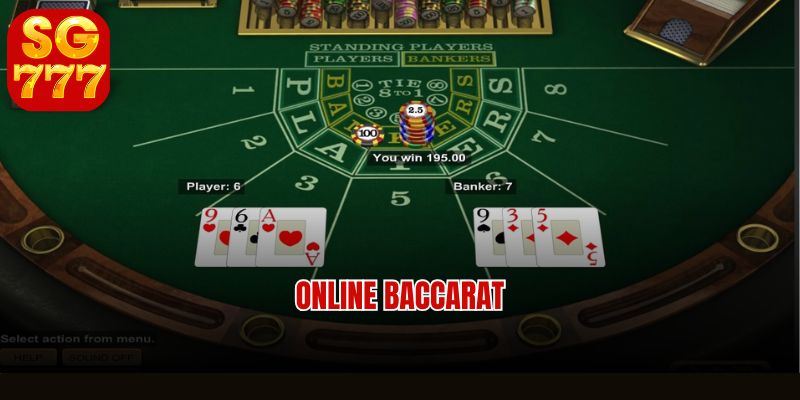
Baccarat is a comparing card game between two hands: Player and Banker. You don’t control either hand; you simply predict which one ends closer to a total of 9—or whether the round ends in a tie. The dealer (or engine) manages all rules automatically, including whether a third card is drawn. This design keeps the game fast and approachable while leaving room for strategic decisions about risk, reward, and session management.
Why Baccarat Appeals to Filipino Players
- Fast rounds: Decisions resolve in under a minute, ideal for short sessions on breaks or commutes.
- Low learning curve: You only need to choose among a few bet options—no complex mechanics.
- Transparent math: Payouts and house edges are well documented, making informed choices possible.
- Flexible stakes: Tables for every bankroll, from casual to VIP.
Cards, Scoring, and Objective
Baccarat uses standard 52-card decks (most commonly 6–8 decks). Suits don’t matter—only ranks and totals:
- Aces = 1
- 2–9 = face value
- 10, J, Q, K = 0
Add the values of the cards in each hand. If the sum is 10 or more, drop the tens digit (e.g., 15 becomes 5). The hand closest to 9 wins. Example: 7 + 6 = 13 → score = 3. A two-card total of 8 or 9 is a Natural; if either side has a Natural, the round stops and the higher total wins immediately.
Third-Card Rule (Handled Automatically)
Whether a side draws a third card follows a fixed decision table (no player choices needed). Understanding the idea helps you follow outcomes:
- Player’s third card: If Player’s first two cards total 0–5, Player draws one more card (except when Banker has a Natural). If Player totals 6–7, Player stands. Totals 8–9 are Naturals.
- Banker’s third card: Banker decisions depend on Banker’s total and, if Player drew, the value of Player’s third card. The dealer applies these rules automatically.
Because these rules are fixed and public, baccarat’s flow is predictable and efficient—one reason it remains a live-dealer favorite.
Bet Types, Payouts, and House Edge
Before your first wager, it’s essential to know both the payout and the statistical edge the house holds on each option:
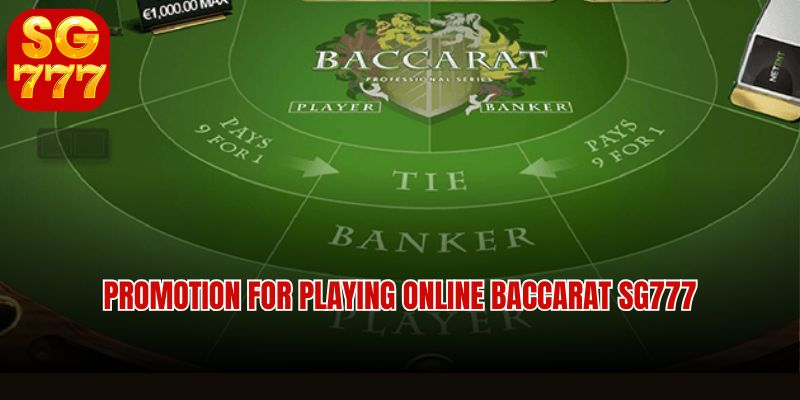
- Banker: Pays 1:1 with a standard 5% commission on wins. Typical house edge ≈ 1.06% (the most favorable long-term bet).
- Player: Pays 1:1 with a house edge ≈ 1.24%.
- Tie: Usually pays 8:1 (sometimes 9:1), but house edge ≈ 14.36% at 8:1—fun but high risk.
Key takeaway: Banker is mathematically the best baseline choice over long horizons, even after commission. Tie, while exciting, should be used sparingly within a clearly defined risk budget.
How to Start Playing at Sg777 (Step-by-Step)
- Create your account: Visit the official site and register an account. Use accurate details to ensure smooth verification and withdrawals.
- Fund your wallet: Choose a payment method you prefer. Deposit small at first while you learn tables and pacing.
- Enter the live lobby: Open the baccarat section in the live casino lobby and browse tables by limit, speed, and provider.
- Pick a table: Start at limits that match your plan (see bankroll section below). Watch a few rounds before your first wager.
- Place your bet: Choose Banker, Player, or Tie, then confirm. The dealer manages all dealing and draws; results and payouts settle instantly.
Playing on Mobile
If you prefer light, on-the-go sessions, install the Sg777 App for smoother navigation, fast table switching, and better battery optimization. Mobile ergonomics matter in a fast game like baccarat—clean UI reduces misclicks and helps you maintain discipline.
Earn by Referring Friends
Content creators and community leaders often partner through Sg777 Affiliates. If you write strategy posts, stream live sessions, or run groups, a compliant affiliate setup can become a meaningful side hustle alongside your own play—just remember to focus on ethical, responsible guidance.
Bankroll Architecture: The Core of Sustainable Play
Professional baccarat isn’t about “secret systems”—it’s about structure. Your bankroll plan determines session length, stress level, and long-term survivability.
Define the Three Layers
- Total Bankroll: The full amount you’re comfortable committing over time (e.g., 40,000₱ across a month).
- Session Bankroll: The chunk you bring to one sitting (e.g., 4,000₱ for a 90-minute session).
- Unit Size: 1–2% of your total bankroll per hand (e.g., 400–800₱ if your total bankroll is 40,000₱). If stress rises, use 0.5–1% instead.
Guardrails That Keep You Safe
- Stop-loss: End the session if you drop 2–3 session units (e.g., −10% of session bankroll). Fresh decisions require a fresh mind.
- Profit lock: Bank part of your gains at +20–30% session profit; don’t give it all back chasing a “perfect” streak.
- Tempo control: Cap hands/hour. Short breaks every 20–30 minutes improve judgment and reduce tilt.
Advanced Betting Systems—How They Really Work

No staking plan can change the house edge, but structure can smooth variance and align risk with psychology. Use these systems as tools, not magic keys:
Flat Betting (Beginner-Friendly)
Wager the same amount every hand (e.g., 1 unit on Banker). Benefits: predictable exposure, long session length, lowest tilt risk. Trade-off: no attempt to exploit streak dynamics.
Paroli (Positive Progression)
Increase after wins, reset after a loss. A common pattern: 1 → 2 → 4 units then reset. This concentrates risk when variance favors you (hot streaks) and limits damage when it doesn’t.
1-3-2-6 (Structured Paroli)
A disciplined four-step progression: start with 1 unit; if you win, go 3; win again, go 2; win again, go 6; then reset. Any loss resets to 1. This captures streak value while capping downside.
Fibonacci (Mild Negative Progression)
After a loss, advance one step in the Fibonacci sequence (1, 1, 2, 3, 5, 8…). After a win, step back two. It’s gentler than Martingale but still risky during long cold streaks.
Martingale (High Stress, Not for Most)
Double after each loss to recover in one win. While the math seems tidy, real-world table limits and finite bankrolls make tail-risk severe. Only consider with strict caps and calm temperament—most players should avoid.
Pro tip: Whatever the system, pair it with Banker bias (the mathematically superior base bet) and strict unit control. Systems shape variance—bankroll policy determines survival.
Reading the Table: Data, Flow, and Discipline
Scoreboards (roads) visualize past results (e.g., Big Road, Bead Plate). Use them as descriptive tools—don’t assume past streaks cause future outcomes. Combine visuals with these practical signals:
- Session texture: Is volatility high (many Ties, frequent alternation) or smooth (longer Banker/Player clusters)? Adjust unit size if the table is choppy.
- Emotional load: If you feel urgency, fear, or euphoria, your risk of mistakes rises. Pause, breathe, reset.
- Table speed: Faster tables magnify errors. If you’re learning a new system, choose normal-speed, not speed baccarat.
Choosing the Right Table
- Limit fit: Your average bet should be comfortably inside the table’s min/max. If you use Paroli or 1-3-2-6, ensure the peak step won’t exceed the limit.
- Provider & view: Clear camera angles, readable roadmaps, and crisp audio reduce cognitive load and errors.
- Pace and vibe: If you feel rushed or pressured, switch tables. Comfort is a performance edge.
Practical Playbooks You Can Copy
Playbook A: Solid Beginner
- Bankroll: 20,000₱ → unit = 200₱ (1%).
- Bet type: Banker only.
- System: Flat betting.
- Stops: −6 units (stop-loss); +8–10 units (lock profit and break).
- Why it works: Lowest decision friction; compounding small edges over long horizons.
Playbook B: Streak-Aware (Controlled Aggression)
- Bankroll: 30,000₱ → unit = 300₱ (1%).
- Bet type: Mostly Banker; occasional Player when you choose to test table rhythm.
- System: 1-3-2-6 or Paroli (reset after any loss or after completing the cycle).
- Stops: −10 units; target +12–15 units per session.
- Why it works: Captures hot streaks while enforcing discipline with structured resets.
Playbook C: Analyst (Data & Tempo)
- Bankroll: 50,000₱ → unit = 250–500₱ (0.5–1%).
- Bet type: Banker baseline; Player only when it improves table fit (e.g., you want to shorten exposure in very slow shoes).
- System: Flat or light Paroli.
- Stops: −8 units; +10–12 units. Hard 90-minute cap per session.
- Why it works: Prioritizes clarity and tempo control, the two strongest anti-tilt tools.
Myths vs. Facts
- Myth: “Tie is the smartest bet because it pays 8:1.”
Fact: Tie carries a very high house edge. Fun as a side play, but not a mainline strategy. - Myth: “A long Banker streak guarantees Player is due.”
Fact: Independent rounds don’t “owe” outcomes. Manage risk; don’t bet out of frustration. - Myth: “Betting systems beat the house.”
Fact: Systems shape variance, not edge. Your advantage is discipline, unit sizing, and table selection.
Responsible Gaming—Your Built-In Advantage
The single strongest edge you can carry into any session is self-management. Adopt these habits:
- Session caps: Timebox each sitting. Fatigue looks exactly like bad luck until you review the tape.
- Reality checks: Log every session (start bankroll, end bankroll, hands played, perceived tilt moments). Patterns appear fast.
- Cooling-off rituals: Stand up, hydrate, reset every 20–30 minutes. If emotions spike, pause immediately.
FAQs: Clear Answers for New and Intermediate Players
Is online baccarat fair?
Live-dealer baccarat is operated by licensed providers with fixed, transparent rules. Shuffles, deals, and third-card decisions follow public procedures. You watch outcomes in real time via multi-angle streams.
What should I bet as a beginner?
Banker at flat 1–2% units is a reliable starting point. It pairs the best long-run odds with the simplest mental model.
How many decks affect odds?
Most games use 6–8 decks. House edges quoted above already assume common multi-deck shoes; differences across providers are small. Focus on bankroll policy and table fit.
Are betting systems allowed?
Yes. Systems are a personal management tool. Remember: they don’t alter house edge—only your exposure and variance profile.
How long should a session last?
Many disciplined players cap sessions at 60–90 minutes or a specific number of hands, with a defined win goal and stop-loss. Consistency reduces tilt and protects profit.
Can I play on mobile?
Yes—install the dedicated app for clean UI, stable streaming, and easy access to history and limits. (See the app section above.)
Join the Action
You now have a complete baccarat blueprint: rules and scoring, payouts and house edge, bankroll architecture, practical playbooks, and myth-busting clarity—all wrapped in responsible-gaming best practices. If you’re ready to experience professional dealers and polished tables, explore the live lobby and choose a table that fits your unit plan, pace, and comfort level.
When you want a refined, high-trust experience, step into Sg777 Live Casino—and bring this framework with you. Treat baccarat as entertainment, respect your limits, and let disciplined decisions turn a good game into a great habit.
